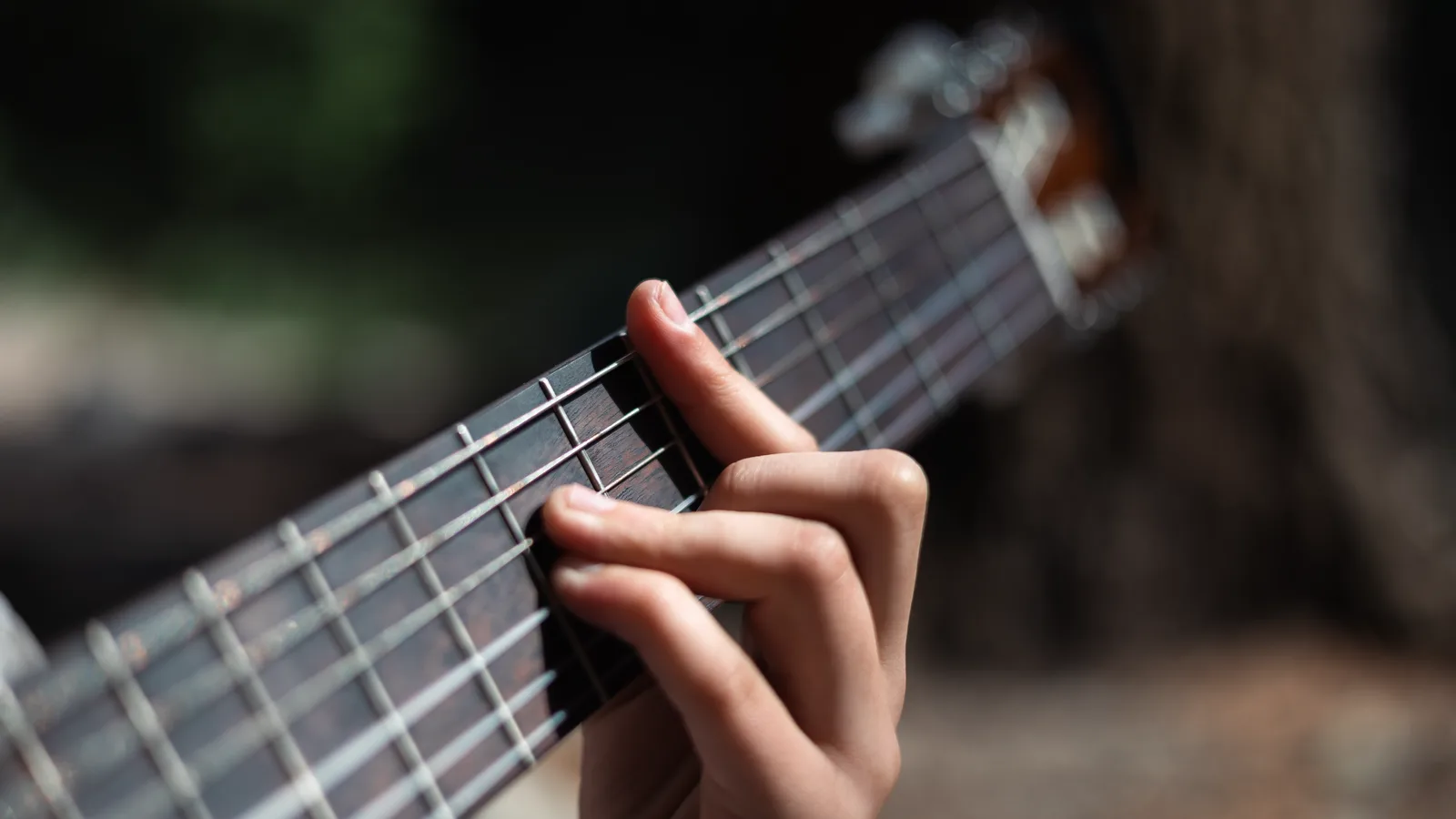
Guitar Lessons Philippines for the player stuck at four chords
Guitar lessons in the Philippines start here by watching you play, because most learners already own a guitar and a few habits. A tutor beside you spots the collapsing fretting hand, the thumb over the neck, the mistake practiced for eight months, and fixes it in person or on a camera that keeps both hands in frame.
4.8 out of 5Average rating from 41 reviews for this program
Program Guide
What is
Guitar lessons
One-to-one acoustic or electric guitar. Unusually among instruments, most learners arrive already able to play something, so a large part of the work is correcting habits formed alone, and then building the things self-teaching almost never reaches, like clean chord changes, timing that does not drift, and knowing why a shape works. Beginners are welcome and are the minority here.
Key Points
1
Acoustic or electric, beginner or self-taught
2
Habit correction as much as new material
3
Chords, strumming, fingerpicking and lead
4
Setup and strings checked in the first lesson
5
Rate shown for your level before you commit
Learning Formats
Two ways to run it
Camera angle decides how well the online version works
1
Online
Online carries chord shapes, strumming patterns, reading and song work at full pace once the camera frames both hands, which the first session sets up. The tutor coaches wrist and finger position through the frame, and a recorded session lets the learner replay each correction during the week.
45-60 minutes
Practice on your own guitar
Needs both hands in frame
Sessions can record for review
2
At your home
Built for beginners and for any habit that needs a hand on it, because the tutor moves a thumb or a wrist into place directly. A home visit runs ninety minutes at minimum, and the first few of those go to checking the guitar itself before any playing starts.
90 minutes
Hand position corrected directly
Your guitar checked in person
Better for young beginners
Reasons to Choose Us
How we teach this
Diagnosis first, because most learners here already play
01
The first session is mostly watching you play
For a self-taught player, adding material before finding the habits produces a stuck player with a bigger repertoire. We look for the three things causing the other ten. Players who would like a second opinion on their hands can move to another guitar tutor free of charge whenever they ask.
02
We check whether the guitar is the problem
Strings sitting too high make an instrument genuinely harder to play, and beginners blame their hands. It is worth ruling out before anybody concludes anything about themselves.
03
Transitions practiced as the skill they are
Holding a chord and reaching the next one in time are separate skills; a song rewards only the second. Most self-taught hands never drill that release-travel-land motion by itself.
04
Time taken seriously
Drifting tempo is invisible from inside and obvious to everyone listening. It is also the thing that decides whether other people enjoy playing with you, which is why the guitar was picked up in the first place.
05
The system behind the shapes
How chords are built and which belong together turns memorization into understanding. It is the missing layer in almost every self-taught player, and it is what makes working out a song possible.
06
Rate before booking
A from-rate for guitar lessons, priced by level and setting; the final number is written down before your first session.
Progression Path
Four players, and most of them are not beginners
Guitar is unusual that way
1
2
3
4
Never held one properlyGenuinely starting
Four chords, one strumming pattern, two yearsSelf-taught and stuck
Gatherings, services, a singer, yourselfAccompanying singing
Solos, riffs, playing in a bandLead and electric
1
Genuinely starting
Never held one properly
The rarest of the four here, because so many people have already tried alone. The priority is getting through the first month, where sore fingertips and chords that buzz cause most of the quitting.
Subjects
Holding it so it does not fight youFirst chords and getting a clean soundFingertips, and what actually happens to themOne song, early
Focus Areas
Surviving the first month
Clean sound before speed
Something recognizable quickly
2
Self-taught and stuck
Four chords, one strumming pattern, two years
The most common learner on this page by a wide margin. Can play songs, cannot get past a specific set of walls, and has usually concluded the problem is talent. It is nearly always a handful of physical habits and one or two missing ideas.
Subjects
Barre chords that actually soundChanging chords without stoppingTiming that does not driftWhy the shapes are the shapes
Focus Areas
Diagnosis before new material
Unlearning, patiently
The specific wall, named
3
Accompanying singing
Gatherings, services, a singer, yourself
The reason most people here pick up a guitar at all. It needs less than players assume: a solid set of chords, reliable time, and the ability to follow a singer or a band leader.
Subjects
Chords that cover most songsStrumming patterns that fit the songKeys, capo and finding a comfortable oneFollowing a singer, including a wandering one
Focus Areas
Reliable time above everything
Useful sooner than it sounds
Playing quietly enough to be sung over
4
Lead and electric
Solos, riffs, playing in a band
Scales, technique and the parts that need accuracy at speed. Also the honest conversation about tone, since a great deal of what beginners hear as skill is amplifier and fingers in roughly equal measure.
Subjects
Scales that mean something musicallyBending, vibrato and getting them in tunePlaying in time with other peopleTone, and what actually produces it
Focus Areas
Accuracy before speed
Musical scales, heard as music
Playing with others as the goal
Program Curriculum
What lessons cover
Starting with what is already there, because for most learners something already is
The first session with a self-taught player is mostly watching them play and working out which three things are causing the other ten. Adding material before that is how a stuck player stays stuck with a larger repertoire.
Strings sitting too high off the fretboard make a guitar physically harder to press, and a beginner will blame their fingers for months. Worth checking before anyone concludes they are not cut out for it.
Topics covered
String height and what it costs you
String gauge, and lighter being legitimate
Whether a setup would fix it
When a cheap guitar is genuinely fine
Service Coverage
Where this is available
Online Tutoring
Anywhere with a usable connection
A fretting hand tucked behind the guitar's neck is easy for a camera to lose, so placement matters more here than for most instruments. Once both hands sit clearly in frame, chords, timing and listening material translate fine over a screen. Guitars stay in the player's own hands every week, and a recorded session lets someone watch their fretting hand later.
Your own guitar every week
Both hands in frame
Sessions can record for review
Timezone: Philippine Standard Time (UTC+8)
In-Person Tutoring
At home, with a hand to move a wrist
In-person guitar lessons suit beginners and anyone with a thumb or wrist habit, since the tutor can set the hand on the neck directly. It's also the only way to have the instrument checked in person, since a stiff grip sometimes belongs to the guitar as much as the player. Send your city, and the guitar tutor nearest you is matched.
Who This Program Serves
Who this is for
Five players, and most of them already own a guitar
Playing for a year or several, improving for none of the recent ones. Usually three physical habits and one missing idea, and almost never the talent they have blamed.
Recommended:
Diagnosis in the first sessionUnlearn before addingThe specific wall named and worked
For a gathering, a service, a choir or themselves. Needs less than they think, and needs the unglamorous half: reliable time.
Recommended:
Chords that cover most songsTime above everythingFollowing a singer
Usually with a guitar that was already in the house. Getting through the sore-fingers month with a recognizable song in hand is most of what decides whether they continue.
Recommended:
A song earlyInstrument checked for playabilityThe ninety-minute visit split into short, varied activities
Often returning to a guitar bought years ago. Adults progress faster than they expect on chords and slower on the physical side, and give up sooner than children out of embarrassment.
Recommended:
Music they actually likeHonest about the first monthPractice sized to a real week
Riffs, solos, playing with a band. Accuracy at speed, scales that mean something, and an honest conversation about how much of the sound is the amplifier.
Recommended:
Accuracy before speedScales tied to musicPlaying with others
6
common pitfalls
What goes wrong
Six walls self-taught players hit
All six are ordinary, and all six get mistaken for a lack of ability
01
Blaming your fingers for the guitar
Why it happens
An instrument with the strings sitting too high takes considerably more force to fret, and a beginner has no reference point for how hard it should be. They assume weak hands, sore fingertips confirm it, and they stop.
Our solution
Have the instrument looked at before anyone draws conclusions. A setup is inexpensive, is not the same as buying a new guitar, and occasionally turns an impossible instrument into an easy one.
02
Barre chords as a brick wall
Why it happens
Usually taught as a strength problem, which sends learners off to squeeze harder. It is mostly geometry (where the thumb sits, how the finger rolls, which part of it touches the strings), and squeezing harder makes all three worse.
Our solution
Fix the position before the strength. Most players who could not barre for a year can produce a clean one in a session once the hand is placed differently, which is both encouraging and slightly annoying.
03
Stopping at every chord change
Why it happens
Practicing chords one at a time builds the ability to hold chords. Moving between them is a separate skill. The song then pauses at each change, and the player assumes they need to know the shapes better.
Our solution
Practice the transition as the thing itself: two chords, back and forth, slowly, watching what the hand does in between. It is the single fastest improvement available to most stuck players.
04
Never playing in time
Why it happens
Time is invisible to a player alone and glaring to everyone else. A player who speeds up in easy bars and slows in hard ones sounds fine to themselves and is difficult to sing with or play alongside.
Our solution
Play to a click, at a speed that is comfortable, regularly. Almost everyone finds this humbling for a week, and it is the difference between being a guitarist and being a guitarist people want to play with.
05
Only ever learning the first eight bars
Why it happens
The intro is the satisfying part and it is where the video is most fun, so a player accumulates thirty song openings and no finished songs. It also means the hard middle sections never get practiced.
Our solution
Finish something. One complete song, all the way through, is worth more than a dozen intros and is a considerably better answer when somebody hands you a guitar.
06
Memorizing shapes with no system underneath
Why it happens
Self-teaching gives a list of chord diagrams and no explanation of how they relate, so every new song is a fresh memorization task and working anything out by ear is impossible.
Our solution
Learn how chords are built and which ones live together in a key. It converts an ever-growing list into a small set of rules, and it is the point where most players start hearing a song and finding it.
The pattern that unites them is that none can be seen from inside. A video has no view of your hands, and a player alone in a room has no way to know which of these is happening.
What guitar lessons cost
The figure below is a starting point. Age, setting and area all move it from there.
From
₱400 / hour
Home visit, Metro Manila
₱550 / hour
Online
₱400 / hour
Home visit, provincial areas
₱400 / hour
Per hour, one tutor with one learner. Home visits run at least 1.5 hours. Packages: 12 hours at 5% off, 24 hours at 10% off.
A guitar rate rises with the player's grade level, the same way every subject on this site is priced: a young child starting out pays less per hour than a teenager working through barre chords, and a teenager pays less than an adult chasing lead guitar. Within a level, a tutor coming to a home in Metro Manila costs more than the same lesson online, and online costs the same as a home visit outside Metro Manila. One weekly session with practice in between is normal for most players here; someone unlearning a stuck habit sometimes adds a second session for the first few weeks while the new movement is still unfamiliar. Buying hours in a block brings the per-hour number down, and suits a player who has already decided guitar is worth the time. Someone still testing the water is better off booking single sessions first.
FAQ
What players ask
The first is asked by nearly every learner who already plays
01
I have been playing for years from videos. Is a tutor worth it?
Yes, and self-taught players often gain the most from one. Videos carry somebody from nothing to playing songs; the next stage is physical, and it needs a person watching the hands. A tutor sees that your thumb has crept over the top of the neck, that you press four times harder than the string needs, or that one small error has been practiced faithfully since last year. If you have stayed at the same level for a while, one of those is almost always the reason, and it is exactly what a tutor in the room corrects from the first lesson.
Other questions
Related Programs
Programs that sit beside this one for the same learner
Tell us what you can already play and where you got stuck
Even a shaky answer works here: which chords you can already switch between, what songs you've attempted, and whether the guitar is acoustic or electric. That detail matters more than players expect, since an instrument fighting a beginner usually gets blamed on the beginner. A tutor looks at what you send and names the actual wall.